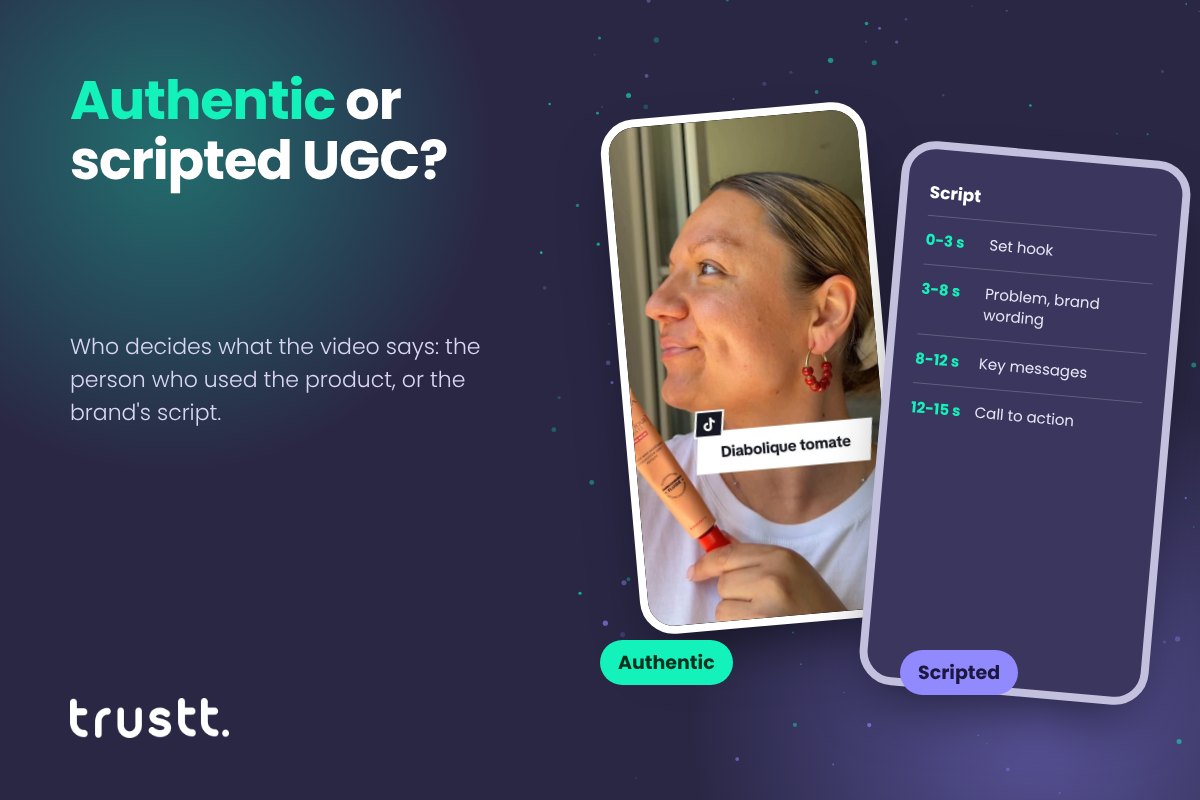
Authentic UGC is made by someone who actually used the product and talks about it in their own words, with no script and no brand sign-off on what they say. Scripted UGC is a commission: a paid creator shoots a UGC-style video from a script, which the brand approves after several rounds of edits.
For most brands, authentic UGC first means creator testimonials on TikTok, Instagram and YouTube. It is also what performs best in paid ads, because it is spontaneous. Scripted UGC, on the other hand, can never be used as a customer review.
- Authentic: the person used the product and chooses their words. The brand chooses the profiles, not the message.
- Scripted: a paid creator reads a script approved by the brand. It is an ad, and must be labeled as one.
- In paid ads: getting 50 authentic UGC and boosting the 10 that outperformed organically beats 10 scripted videos ordered in advance.
- Scripted UGC done right: ordered from the most engaged creators of the brand’s own community, spotted through gifting.
- On product pages: only authentic UGC can become reviews or testimonial stories.
- The risk: passing scripted UGC off as a customer review is a fake review, banned in the EU, the US and the UK.
What is authentic UGC?
Authentic UGC (user-generated content) is content created by a consumer or a creator who tried the product in real life. The brand chooses who receives the product. It does not choose what they say.
For most brands, it mainly takes the form of creator testimonials on TikTok, Instagram and YouTube. Video, Reel, story or Short: the creator posts on their own account, to their own audience. It also comes as written or video reviews, before/after photos, unboxings and tutorials.
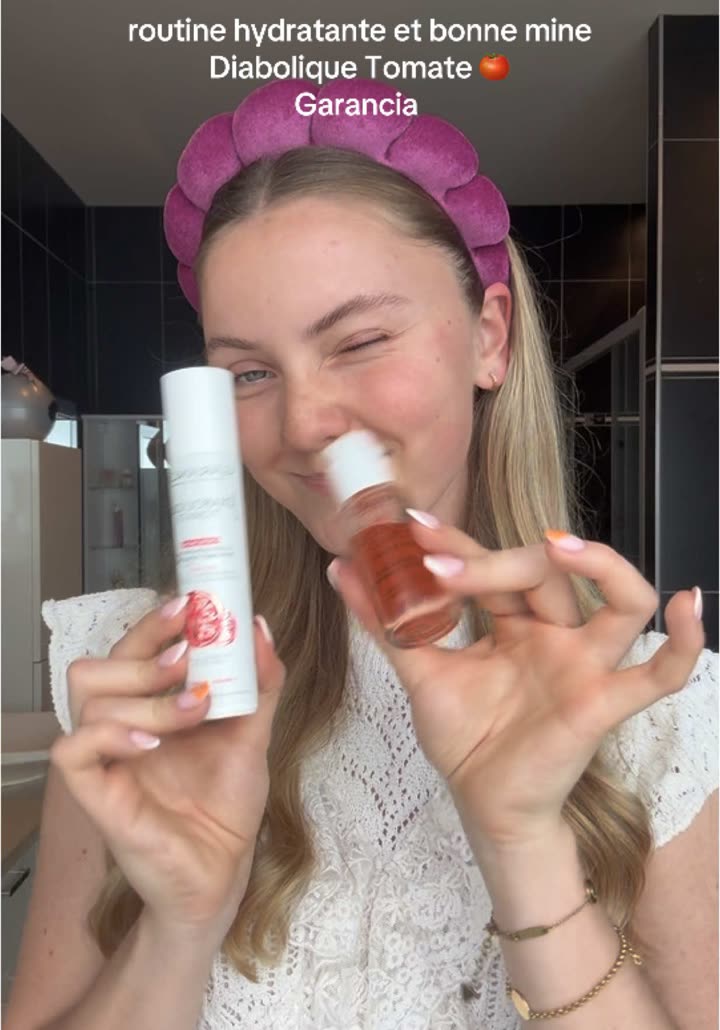 Garancia · moisturizing routine
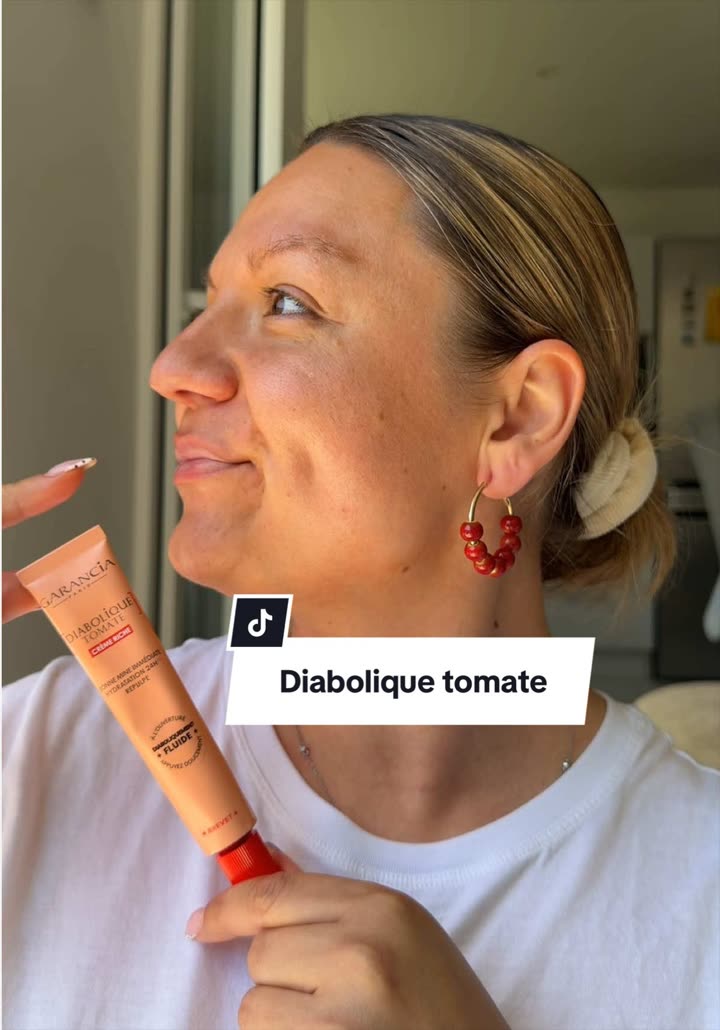 Garancia · Diabolique Tomate
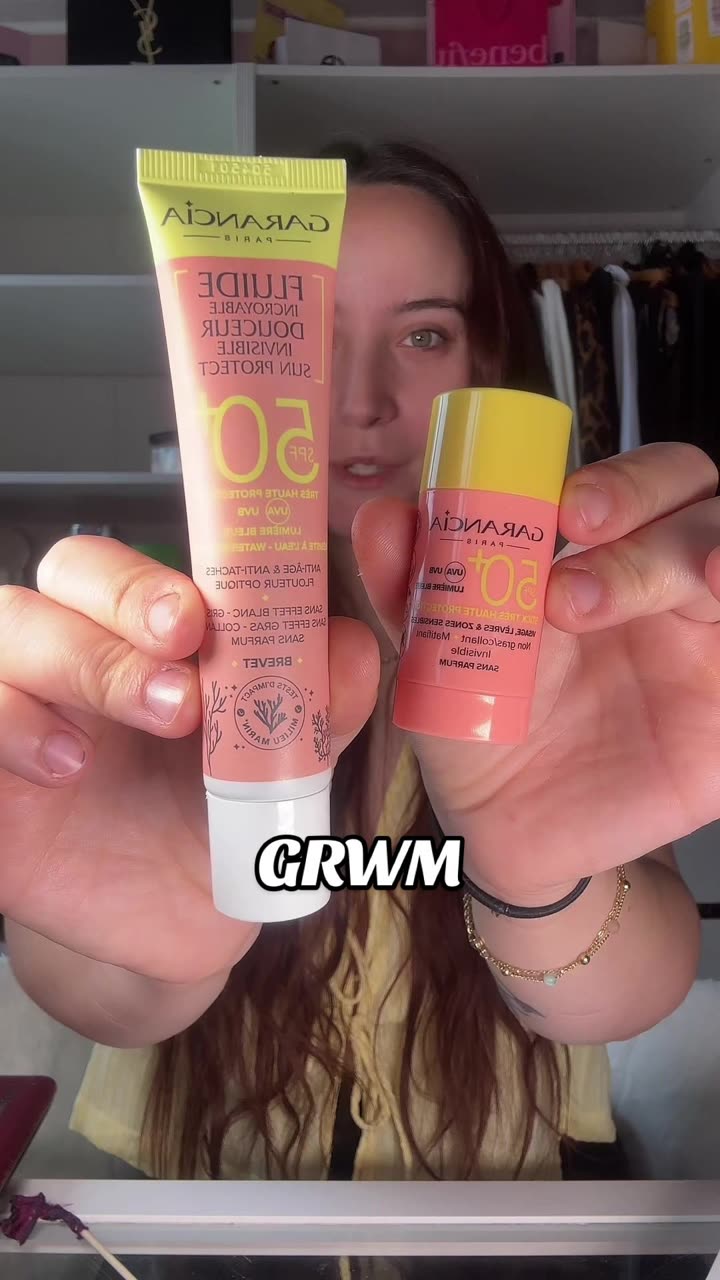 Garancia · get ready with me
It is usually obtained through an ambassador program: the brand recruits its own ambassadors, sends them the product with an inspiration brief, and collects what they post. That is how Garancia gathered 5,044 TikTok and Instagram posts with its ambassador community between April 2025 and June 2026 (Garancia case study).
An inspiration brief, not a script
Authentic does not mean without guidance. The brief sets a theme, a mission, a trend to follow and a few examples of videos that work. It never tells the creator what to think of the product.
There is no back-and-forth on the message: the ambassador stays free to be nuanced, or even disappointed. The partnership disclosure states that this is an honest review of a gifted product.
Inspiration brief (authentic UGC)
- Mission
- Take the product to the beach and show your summer routine.
- Trend
- “Come with me”: a format the community already uses.
- Examples
- Three ambassador videos that performed well.
- What the creator says
- Their opinion, their words, flaws included.
Script (scripted UGC)
What is scripted UGC?
Scripted UGC is an advertising video shot by a paid creator, often cast like an actor. It borrows the codes of UGC: talking to camera, smartphone, everyday setting. The brand provides the brief, the script, the hook and the key messages, then approves the result after several rounds of edits.
Scripted UGC cannot be used as a testimonial of efficacy: it is an ad commissioned by the brand, and the video must say so clearly. Brief constraints also weigh on the result. Without a talking head, for instance, the hook often loses its punch and the video feels more corporate.
It is also called paid UGC, UGC ads or paid UGC creators. The creator’s follower count does not matter: they sell a production, not an audience. The video runs on the brand’s own accounts and in paid ads.
A scripted video costs between €200 and €1,500 depending on requirements (range observed by Trustt in France in 2026). Swello puts beginner creators at €150 to €200 per video and premium profiles above €800 (Swello, 2026).
What is the difference between authentic and scripted UGC?
The difference comes down to one question: who decides what the video says? With authentic UGC, it is the person who used the product. With scripted UGC, it is the brand.
| Criterion | Authentic UGC | Scripted UGC |
|---|---|---|
| Who speaks | A creator or consumer who used the product | A creator paid for a production |
| Where it is posted first | On the creator’s account (TikTok, Instagram, YouTube) | On the brand’s accounts and ads |
| What the brand controls | Profile selection, inspiration brief, moderation | Script, hook, editing, approval |
| Compensation | A gifted product, sometimes a fee | A fee per video |
| Cost | Product, shipping, software | €200 to €1,500 per video (Trustt, France, 2026) |
| Volume | Dozens to thousands of posts per program | A few videos per order |
| What it proves | That the product is liked and shown | Nothing about real use: it is a brand message |
| Required disclosure | Partnership disclosure as soon as there is compensation | Ad or paid partnership label |
| Review, rating, product page story | Yes | Never as a testimonial |
| Paid ads | Yes, the best performers, rights assigned | Yes, its main use |
Why does spontaneity drive ad performance?
An ad that looks like an ad gets skipped. A video shot by a real user, at home, in her own words, gets watched to the end. Social platforms reward what holds attention, and spontaneity holds it better than production value.
Spontaneity drives performance, not production value.
Scripted UGC tries to imitate that spontaneity. The script often kills it: sentences sound the same from one creator to the next, and the tone feels rehearsed.
Marketing teams at beauty and health brands say it in meetings. Their scripts “repeated the key messages” without the codes of the platform. The result: few views, little engagement, and a lack of authenticity the audience notices.
Brands working with Trustt see the same thing. When both formats are tested in the same campaign, spontaneous content selected on its organic results outperforms scripted videos. And it does not put the brand at risk.
Why get 50 authentic UGC rather than order 10 scripted ones?
Because the brand picks its ads on results, not on promises. With 50 posts published by its ambassadors, it sees which ones get the most views, comments and shares organically. It then boosts the 10 that outperformed.
With 10 scripted videos, the brand pays upfront for 10 bets, none of them tested on a real audience. The script makes them weaker in tests, and a single badly presented video is enough to create a fake review risk.
The method in four steps
- 01RecruitAn ambassador community, from a few dozen to several hundred per campaign.
- 02LaunchA creative mission with an inspiration brief, no script.
- 03MeasureThe posts on the creators’ accounts: reach, views, comments.
- 04BoostThe best ones in paid ads, with rights already assigned.

Up to 20% lower CPA on a paid campaign using ambassador content, according to Marilou, Influence Manager at Blissim (video testimonial in French, July 2025).
Since 2023, more than 4,100 ambassadors have published more than 5,700 social posts for Blissim (Blissim case study, figures published in August 2025).
This figure applies to that campaign, not as an average to expect elsewhere.
Why can scripted UGC never become a customer review?
Presenting scripted UGC as a customer testimonial is a fake review, and the three main markets for European beauty brands now ban it explicitly.
An actor reading a script who then appears in the review module of a product page falls under these rules. The rule is simple: a review, a rating or a testimonial only comes from someone who actually used the product. Scripted content stays in ad placements, labeled as such.
Can authentic UGC be paid?
Yes. Authenticity does not depend on the absence of compensation, but on the absence of a script. An ambassador who receives a free product, or even a fee, stays authentic as long as they freely say what they think, flaws included.
The compensation must, however, be visible. In France, the June 9, 2023 influencer marketing law requires a clear “collaboration commerciale” label; in the US, the FTC Endorsement Guides require disclosing any material connection. A free product is enough to trigger the obligation.
How do you turn UGC into product page stories?
Authentic UGC does not stop at the social feed. Ambassador videos also run on the brand’s website, as stories on product pages, where the purchase is decided. Visitors see the product used by real people without leaving the page.
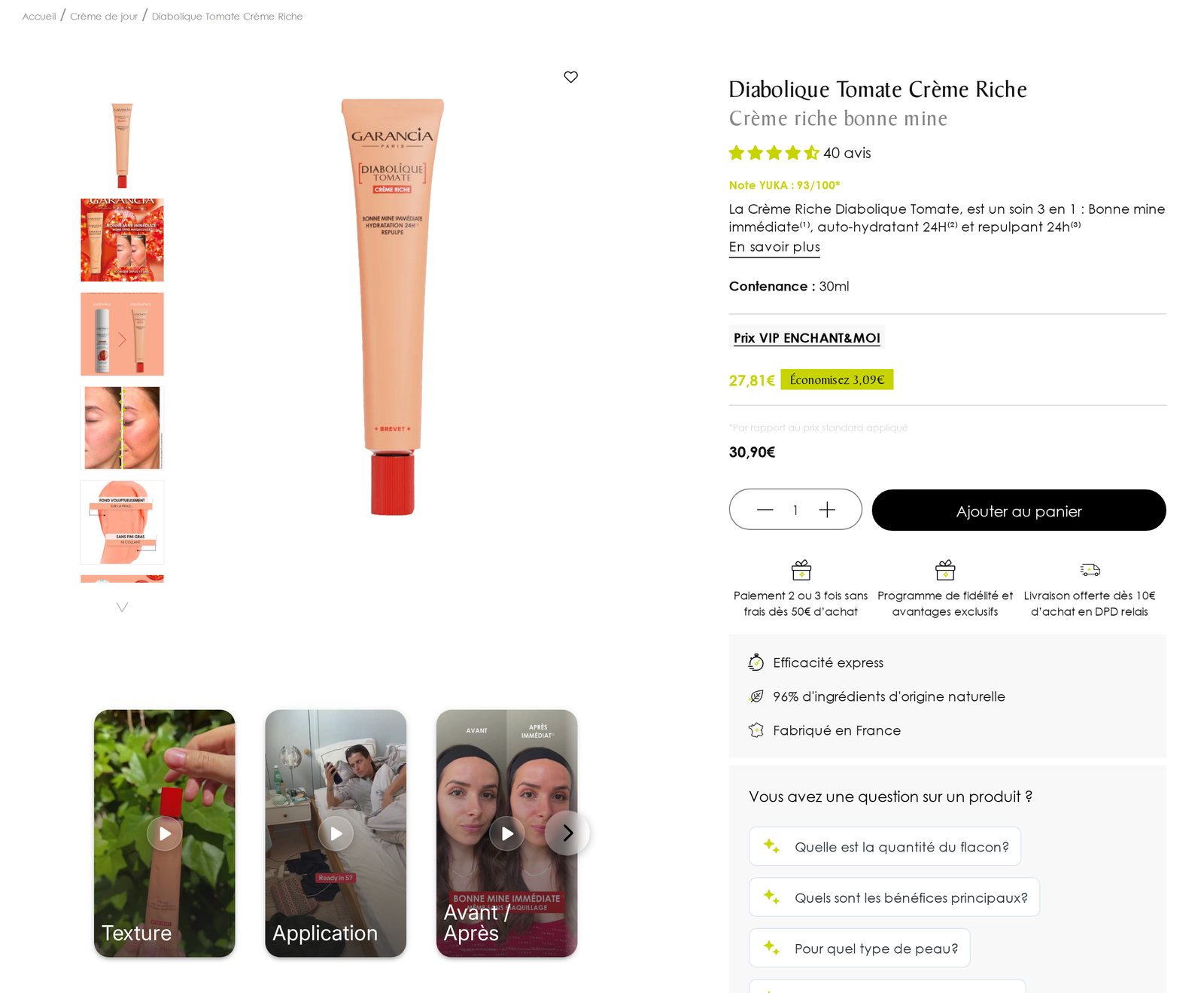
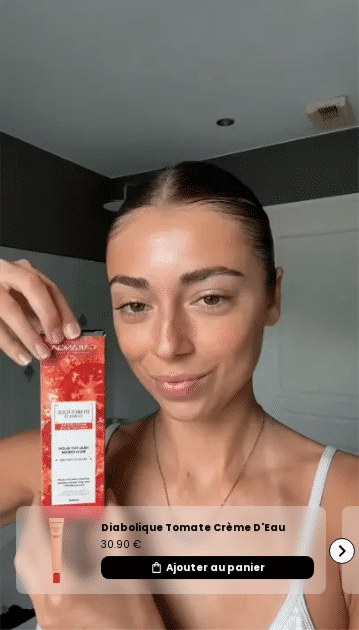
Since July 16, 2025, Garancia has added an ambassador story module to 30 of its product pages. Six of these stories cover the Diabolique Tomate rich cream. They run on Snackeet, the interactive story solution from Trustt.
Scripted UGC has no place in these stories when they are presented as testimonials. Here again, only content from a real user can speak for customers.
Which UGC should you choose for each use?
The right format depends on where it runs. Advertising buys attention, proof converts it.
| Use | Format | Why |
|---|---|---|
| Paid ads (Meta, TikTok) | Authentic, selected on organic results; scripted as a complement | Spontaneous content has already proven itself with a real audience |
| Product page: reviews and stories | Authentic only | Only a real user can speak for customers |
| Organic social | Authentic | The community spots a pre-written message |
| Product launch | Authentic, with a home-use test | Proof available from day one |
| Retailer pitch | Authentic | A retail buyer wants proof, not an ad |
| Supplements, pharmacy products | Authentic first | In scripted UGC, every sentence binds the brand like an ad, health claims included |
When is scripted UGC the right choice?
Scripted UGC is the right tool when the brand needs to control every second of the video. It is an effective ad format, as long as it is used as one.
- A precise demonstration: an application gesture, a multi-product routine, a before/after shown step by step.
- A set format: short duration for Meta, voice-over with no talking head, versions in several languages or packagings.
- A message to say word for word: a regulatory mention, a retailer to name, a claim approved by the regulatory team.
- Variants to test: several hooks on the same message, to find the one that lowers cost per acquisition.
The method of the most advanced brands
The most advanced brands do not choose between the two formats: they chain them. They start with gifting, which produces authentic reviews and content. Then they order their scripted UGC from the creators who proved the most engaged.
- 01GiftSend the product to program ambassadors, with an inspiration brief.
- 02CollectReviews, posts and authentic videos, at volume.
- 03SpotThe most engaged creators: content quality, engagement, consistency.
- 04PayScripted UGC ordered from these creators, labeled as ads.
That creator already knows the product, uses it, and has an audience that trusts them. The script builds on benefits they noticed themselves: the video is still an ad, but it rings true. The brand also avoids blind casting of actors who do not look like its customers.
Trustt supports brands on both formats: the ambassador program for authentic UGC and, as an add-on, scripted UGC production. Creator selection within the brand’s community, brief, script, rounds of edits and rights assignment are all handled.
How do you spot scripted UGC?
Scripted UGC gives itself away by its structure, authentic UGC by its rough edges. That is exactly what makes the latter credible.
Signs of scripted UGC
- A three-second hook, then problem, product, demo, call to action.
- The same sentences from several different creators.
- The brand name repeated, key messages recited.
- No flaw, no length of use.
Signs of authentic UGC
- A real setting: bathroom, kitchen, pharmacy counter.
- A length of use: “after three weeks”.
- A nuanced opinion, sometimes a flaw.
- The person’s own tone, the same as in their other posts.
What do consumers say?
Creators trigger the purchase, reviews reassure. In The French Pharmacy Club Barometer, 66% of people who bought a skincare product seen on social media name as the trigger the video of a creator they follow (41%) or of someone they do not follow (26%), rounded figures.
What triggered the purchase
Buyers of a skincare product seen on social media, base 620
Other answers not shown (6%).
Who they trust first to choose a skincare product
All respondents, base 952
Other answers not shown (16%).
To choose a skincare product, the same respondents first trust reviews from other consumers (33%), ahead of the pharmacist (28%). Creators are named by only 4%: the video drives discovery, the review drives the decision.
Who owns the rights to authentic UGC?
The brand, if the program provides for it. With Trustt, creators assign the rights to their content to the brand when they apply to its ambassador program: it is the condition for being selected and receiving the product.
The brand can therefore reuse their videos in ads, on its website and as product page stories, without negotiating content by content. Volume is automated (recruitment, shipping, reminders), quality stays with the brand: profile selection, content choice, moderation.
Is AI-generated UGC still UGC?
No. An AI-generated avatar video is neither user content nor a testimonial: it is synthetic advertising. Presented as a consumer review, it is a fake review, and the FTC rule explicitly covers reviews from people who do not exist.
Since August 2, 2026, Article 50 of the EU AI Act adds transparency obligations for AI-generated content. At Trustt, AI generates formats (subtitles, translations, stories), never voices: it never writes a review.
FAQ on authentic and scripted UGC
What is the difference between organic and paid UGC?
Organic UGC is posted spontaneously by a customer or creator, with no script. Paid UGC is ordered, scripted and paid for. An ambassador program organizes authentic UGC: the brand chooses the profiles and sends the product, without writing the message.
Can scripted UGC be shown as customer reviews?
No. A review can only come from someone who actually used the product. Presenting scripted content as a review is a fake review, banned in the EU, the US and the UK.
Which UGC performs best in ads?
Spontaneous content, selected on its results. The method is to get many authentic UGC (for example 50), spot those that outperformed organically (for example 10), then boost them in ads. Blissim saw up to 20% lower CPA on a campaign using its ambassadors’ content.
Does authentic UGC need a paid partnership disclosure?
Yes, as soon as the ambassador received any compensation, a free product included. The disclosure must be clear and visible, as required by French law and the FTC Endorsement Guides in the US.
Can a brand reuse authentic UGC in ads or on product pages?
Yes, if it owns the rights. With Trustt, creators assign the rights to their content to the brand when they apply to its ambassador program. The brand can run it in ads, on its website and as product page stories.
When should you use scripted UGC?
When the brand needs to control every second: precise demonstration, set format, regulatory message, hook variants to test in ads. It works best when ordered from the most engaged creators of its ambassador program, spotted through gifting.
How much does scripted UGC cost?
Between €200 and €1,500 per video depending on requirements (range observed by Trustt in France in 2026). Paid ad usage rights often raise the price.
Is AI-generated UGC allowed?
It is allowed as labeled advertising, never as a consumer review or testimonial. The EU AI Act adds transparency obligations for AI-generated content since August 2, 2026.
Give every brand its own ambassadors, and the proof they produce.
Book my demoMore than 150 beauty, nutrition and pharmacy brands have recruited their ambassadors with Trustt since 2014.
Sources
- Garancia case study, Trustt, published September 18, 2026 (in French): trustt.io/etude-de-cas-garancia
- Blissim case study, Trustt, figures published in August 2025, and video testimonial from Marilou, Influence Manager (July 2025, in French): trustt.io/etudedecasblissim
- French Consumer Code, articles L.121-4 (28°) and L.132-2: Légifrance
- French law no. 2023-451 of June 9, 2023 on influencer marketing: Légifrance
- Federal Trade Commission, final rule banning fake reviews and testimonials, August 14, 2024: ftc.gov
- Competition and Markets Authority, new consumer protection regime (DMCC Act), April 7, 2025: gov.uk
- EU Artificial Intelligence Act, Article 50: EUR-Lex
- Swello, “Qu’est-ce qu’un créateur UGC rémunéré ?”, 2026: swello.com
- The French Pharmacy Club Barometer, Trustt and Pharmacie Eiffel Commerce, 952 respondents, September 22 to October 29, 2026

Emmanuel Nunez
CEO and co-founder of Trustt, ambassador program software for beauty, nutrition and pharmacy brands. More than ten years in consumer reviews and micro-influence. LinkedIn