By Emmanuel Nunez, CEO of Trustt, more than ten years in reviews and brand ambassador programs for beauty, nutrition and pharmacy brands. Updated on October 10, 2026.
A consumer panel is a group of consumers recruited on precise criteria and questioned repeatedly about their purchases, their use of a product or their opinion of it. There are four families, from retail measurement panels that track sales to a brand-owned panel made of the brand’s own ambassadors, and the right choice depends on the question: sizing a market, validating a formula or supporting a claim.
For a product manager preparing a launch, the question is rarely “does the brand need a panel?”. It is which panel will give a reliable answer in time, with results the brand can reuse on its product pages and in its retailer pitch.
Table des matières
What is a consumer panel?
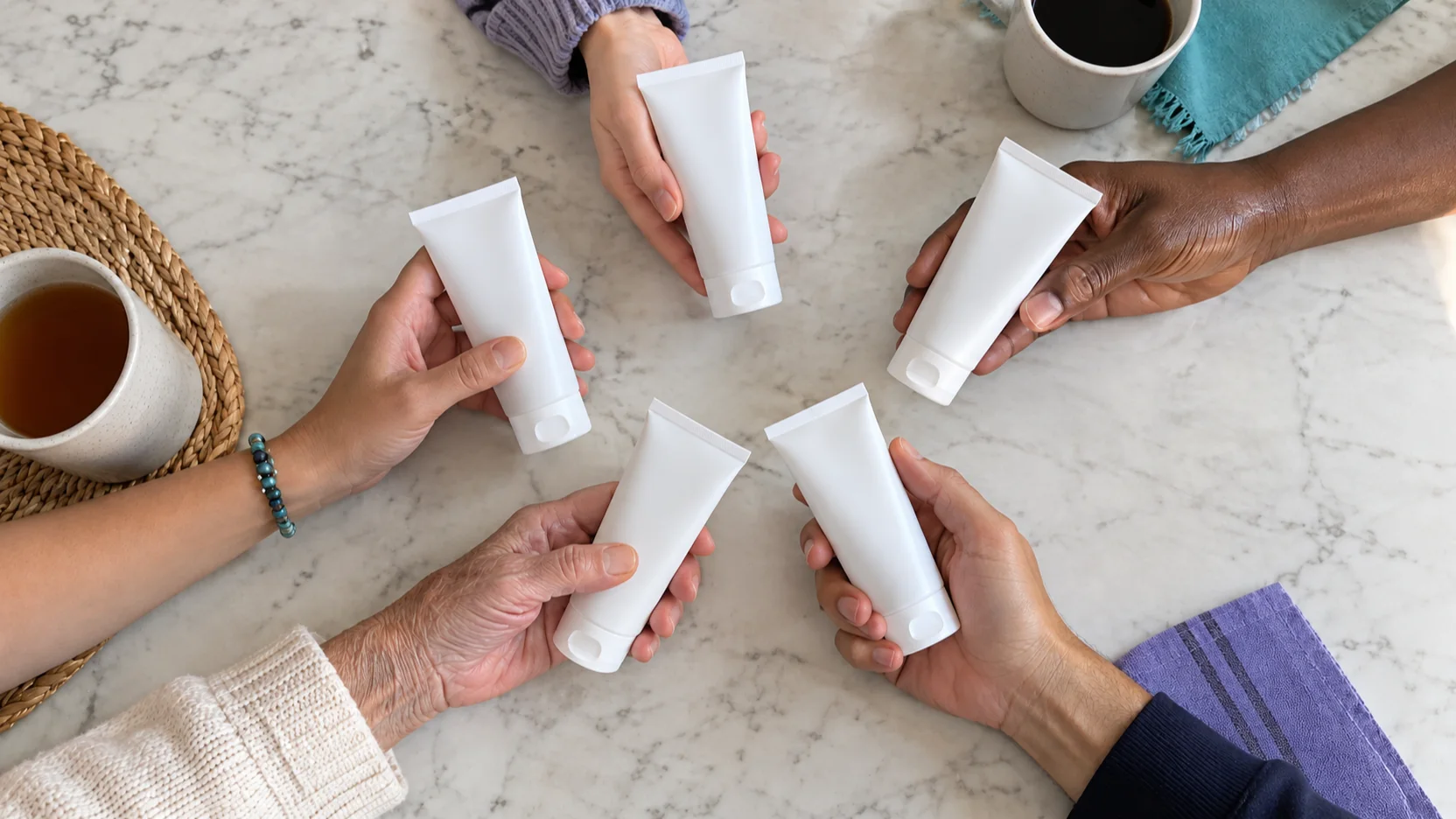
A consumer panel is a stable sample of people, selected on criteria (age, skin type, buying habits, product category), who answer questions several times over a period. Its difference from a one-off survey is time: the same people answer again, so the brand can compare before and after.
Panelists are volunteers. They answer online (questionnaire, usage diary), at home (testing the product in their routine) or in a central location (tasting, sensory booth).
“Marketing panel” is the umbrella term. It covers every panel used to make a marketing decision, including panels that track stores rather than people.
What are the main types of consumer panels?
A product manager meets four families of panels: retail measurement panels, household purchase panels and research agencies, online sample panels, and the brand’s own panel of ambassadors. They do not answer the same questions and do not leave the same data with the brand.
Table 1. The four families of panels compared on what matters for a product launch (public sources checked on October 11, 2026).
| Criterion | Retail measurement panel | Household purchase panel or research agency | Online sample panel | Brand-owned panel (the brand’s ambassadors) |
|---|---|---|---|---|
| What it measures | Store sales by item and by retailer | Real purchases of a representative sample of households, or opinions in an ad hoc study | Opinions of respondents recruited by a sample provider, on a questionnaire | Real use of the product by consumers who applied to test it |
| Example providers | Circana (built on IRI and NPD), NielsenIQ retail measurement | NielsenIQ Homescan (more than 250,000 households in 25 countries), Worldpanel by Numerator, Ipsos | Online sample and survey panel providers | The brand itself, with ambassador program software |
| Typical use | Market share, distribution, pricing, shelf performance | Penetration, loyalty, buyer profiles, concept or product tests | Concept, packaging and price tests; fast studies at volume | Home use test before or after launch, first reviews, content, product learnings |
| Timing | Continuous data, delivered by period | Several weeks for an ad hoc study (scoping, recruiting, fieldwork, report) | Days to weeks: the rarer the target, the longer the fieldwork | 3 to 4 weeks of use in the published examples below, plus recruiting time |
| Indicative cost | Subscription on quote, no public price | Ad hoc in-home usage tests quoted at $15,000 to $75,000+ by one test vendor (Table 3) | $2 to $8 per complete for a broad US consumer target, multiplied for a rare target (Table 3) | Software license, products shipped and logistics; no cost per respondent |
| Data ownership | The provider; the brand buys a license to use it | The provider; the brand receives a report | The provider; the brand receives anonymized answers | The brand, which keeps consented profiles and the history of answers |
| Reuse as reviews and content | None | Rare (aggregated, often confidential) | Rare | Reviews published with the incentive disclosed, perception claim with asterisk, ambassador photos and videos |
Sources: NielsenIQ, Consumer Panel page, modified June 29, 2026; Circana, company page; Highlight, “How Much Does an IHUT (or CLT) Cost? A 2026 Breakdown”, July 23, 2026; Drive Research, updated August 12, 2026; Vital Proteins case study (in French) and ENO case study (in French) for usage durations.
A fifth option sits next to these four: the testing lab, which recruits a panel on demand for a single test. One European lab, for example, lists in-use cosmetic tests on 10 to 50 people over 7 to 28 days, priced from €450 to €1,250 depending on panel size (Certified Cosmetics, “In-use Cosmetic Test”, modified July 27, 2026).
Retail panel or consumer panel: what is the difference?
A retail measurement panel sees what leaves the store checkout; a consumer panel sees what enters the household. The first tells how much an item sells and where, the second tells who buys it, how often and what they bought before.
Neither tells whether the product keeps its promise once used. That gap is what sends product managers toward the home use test, run by an agency, a lab or the brand itself.
What can a consumer panel test before a launch?
Before a launch, a consumer panel checks that the product is liked, understood and does what it says, from the point of view of the people who use it. After launch, the same panel tracks satisfaction and feeds the first reviews.
In practice, panel feedback answers five kinds of questions:
- The formula: texture, scent, perceived tolerance, taste for a supplement.
- The directions: dose actually taken, time of application, usage mistakes.
- The packaging: legibility, opening, understanding of the stated benefits.
- The promise: do users notice what the brand plans to print on the carton?
- Price and channel: repurchase intent, acceptable price, where they would buy it.
The answers then support a decision: adjust the formula, rewrite the promise, or keep the launch date.
What is a home use test (HUT), and what can its results support?
A home use test (also called an in-home usage test, or IHUT) has a targeted panel use the product for a set period, often three to four weeks, then collects each participant’s self-assessment in a questionnaire. It measures perceived, self-reported results, not clinical efficacy.
In the US, advertising claims need a reasonable basis before they run. For health claims, the FTC asks for “competent and reliable scientific evidence” and states that anecdotal evidence and testimonials “are never sufficient to substantiate claims about the effects of a health product” (FTC, Health Products Compliance Guidance, December 20, 2022). A home use test therefore supports what participants report (feel, texture, satisfaction, perceived effect), presented as such, in three inseparable parts:
- The claim, followed by an asterisk.
- The asterisk, which states the method: home use test, self-assessment, number of participants, duration, period.
- The figure, worded as what participants reported.
Here is an example published by a brand, illustrating a single campaign:
“Gives skin a radiance boost*”
*Home use test, self-assessment by 60 users, 28 days, September to November 2025.
98.3% say the duo gives their skin a radiance boost.
Source: ENO / Laboratoire Codexial case study, “Protocole Éclat du Teint” test (in French). Perceived and self-reported efficacy, not clinical efficacy.
Cosmetic or drug: the claim decides. The FDA states that whether a product is a cosmetic or a drug “is determined by a product’s intended use”, and that claims such as restoring hair growth, reducing cellulite or regenerating cells make it a drug (FDA, “Is It a Cosmetic, a Drug, or Both?”, current as of September 11, 2024). A home use test does not change that line: a well-run test can support “skin feels softer”, never a drug claim.
The case of dietary supplements. A home use test informs on satisfaction, taste, ease of use and how participants feel, but it supports no health claim. Under the framework created by DSHEA (1994), a structure/function claim needs substantiation that it is “truthful and not misleading” and must carry the FDA disclaimer; only a drug can claim to treat, cure or prevent a disease (FDA, Questions and Answers on Dietary Supplements, current as of August 27, 2026). Vital Proteins accordingly presents its usage test results as “self-reported feedback, with no value as a health claim” (Vital Proteins case study, in French).
For brands also selling in the EU (EU rules). Cosmetic claims must rest on adequate and verifiable evidence under Regulation (EU) No 655/2013, and supplement health claims are limited to those authorized under Regulation (EC) No 1924/2006.
When is a brand-owned panel enough, and when is a research agency needed?
A brand-owned panel is enough when the brand wants to know how its own customers use the product, and to reuse their answers. An agency or a lab remains necessary as soon as the question calls for national representativeness, an instrumental measurement or clinical supervision.
Table 2. Choosing between a brand-owned panel and an outside provider, by question.
| Product manager’s question | Brand-owned ambassador panel | Agency, lab or purchase panel |
|---|---|---|
| Do texture, scent or taste appeal to the target? | Yes | Yes |
| Are the directions understood? | Yes | Yes |
| Do users notice the stated effect (perception claim)? | Yes, with asterisk | Yes |
| Are publishable first reviews needed on launch day? | Yes | No |
| What market share, what national penetration? | No | Yes (retail or household purchase panel) |
| Is a result representative of the US population needed? | No, the panel is self-selected | Yes (quotas, weighting) |
| Is an instrumental measurement needed (measured hydration, wrinkles, sebum)? | No | Yes (lab) |
| Should the pack say “dermatologist tested” or “clinically tested”? | No | Yes (supervised protocol) |
| Is it a health or drug-type claim? | No | Requires competent and reliable scientific evidence, generally controlled clinical trials (FTC) |
Source for the last row: FTC, Health Products Compliance Guidance.
In practice the two are often combined: the lab or agency for the instrumental or clinical claim, the brand-owned panel for perception claims, reviews and content.
How does a brand build its own panel from its ambassadors?
A brand builds its own panel by opening a call for applications, selecting the profiles that match the product’s target, then shipping the product with a questionnaire to complete after the usage period. The panelists are its own ambassadors: consumers who test and rate, and sometimes creators who publish to their audience.
The steps, in order:
- Set the question. A claim to check, directions to validate, a formula to compare. One question per program.
- Open applications on the brand’s site, newsletter, social accounts or in store, with an application questionnaire (habits, skin type, expectations).
- Select on criteria written in advance (quotas by age, skin type, category use), so the panel is not made of fans only.
- Ship the product and announce the questionnaire date.
- Collect the self-assessment after the usage period (three weeks for a supplement, 21 to 28 days for skincare), with neutral questions.
- Analyze and decide: which results hold, on how many respondents, for which claim.
- Reuse: claim with asterisk, reviews published with the incentive disclosed, photos and videos from ambassadors, who assigned their rights to the brand when they applied, export for the retailer pitch.
Example: Vital Proteins
From April 2025 to March 2026, Vital Proteins ran four programs on its collagen supplements: 2,484 applications, 706 ambassadors selected, 568 reviews published and 512 usage tests completed three weeks after the product arrived. The questionnaire covered the dose taken, how the product was consumed, satisfaction and perceived effects, so the brand compares applicant profiles with real use. The programs ran on Trustt, the ambassador program software the brand uses to recruit, select and question its ambassadors. (Vital Proteins case study, in French.)
Control stays with the brand: it sets the selection criteria, approves the questions, moderates reviews and decides what gets published. Ambassadors join for free.
How large should a panel be, and which biases matter?
There is no universal size: the number of participants follows from the question and the precision needed, and the test report should explain the choice. As a benchmark, one lab’s public in-use cosmetic test offer ranges from 10 to 50 people (Certified Cosmetics).
A brand-owned panel can recruit more widely than needed, then select. In the ENO example above, 727 applications led to 70 selected ambassadors and 60 questionnaires completed after 28 days (ENO case study, in French).
Four biases deserve attention, whatever the type of panel:
- Self-selection: people who apply already like the brand or the category. Selection quotas limit the effect.
- Free-product effect: a free product can soften judgment. Neutral questions and a visible incentive disclosure next to reviews account for it.
- Attrition: not everyone answers. Results are reported on the number of respondents, never on the number selected.
- Conditioning: a panelist questioned too often starts answering like an expert. Renewing part of the panel at each program keeps answers spontaneous.
What do US rules say about reviews and data from a product-testing panel?
Reviews written by panelists who received a free product are endorsements with a material connection: the FTC answers “Yes” to whether a free product must be disclosed, and states that an incentive cannot be conditioned on a review being positive (FTC, “FTC’s Endorsement Guides: What People Are Asking”, Guides revised in 2023, page modified July 15, 2025). The same page warns that asking only likely-happy customers for reviews, or delaying only negative ones, can mislead.
Since October 21, 2024, the FTC’s Trade Regulation Rule on the Use of Consumer Reviews and Testimonials (16 CFR Part 465) prohibits incentives “conditioned on the writing of consumer reviews expressing a particular sentiment”, and bars presenting a review section as complete when reviews were filtered out by rating (FTC press release, August 14, 2024; Federal Register, August 22, 2024). For a brand-owned panel, that means inviting every tester to review honestly and publishing negative reviews too, as described in Trustt’s review authenticity policy.
Panel data is personal data. Several US states have their own privacy laws: in California, the CCPA gives consumers the right to know what is collected, to delete it, to correct it and to opt out of its sale or sharing (California Attorney General, CCPA page, updated August 28, 2026). For a brand-owned panel, that translates into a separate opt-in for each use: taking part in the test, receiving new invitations, letting the brand reuse a photo. For European panelists, GDPR consent rules apply (EU rule).
The difference with a rented panel is ownership. With an agency, the brand receives a report; with its ambassadors, it keeps consented profiles and the history of their answers, program after program. This first-party data then helps target the next test without starting from scratch.
How much does a consumer panel or a home use test cost?
The cost of a panel depends less on the number of respondents than on what has to be recruited, shipped and analyzed. A retail panel subscription, an agency study, a lab test and an ambassador program can only be compared on full cost.
A fair comparison adds up:
- The provider or license: study report, data subscription or ambassador program software.
- The products shipped to panelists and their logistics.
- Internal time: brief, follow-up, analysis, claim review.
- What remains afterward: a confidential report, or answers, reviews and content the brand can reuse.
The price of a panel depends first on the incidence rate: the share of people screened who match the target. A broad target costs a few dollars per completed questionnaire; a rare one can cost ten times more.
Table 3. Public cost benchmarks for panels and home use tests (checked on October 11, 2026).
| What is bought | Order of magnitude | Source |
|---|---|---|
| Online survey, general US consumers, 3 to 5 minutes | $2 to $8 per complete | Drive Research, updated August 12, 2026 |
| Online survey, niche target, 10 minutes | $35 or more per complete | Same source |
| Rarity effect (incidence rate) | 1.5 to 2 times baseline at 30 to 50% incidence; 3 to 5 times at 10 to 20%; 8 to 15 times under 5% | Koji, updated September 15, 2026 |
| In-home usage test (IHUT) run by a test vendor | $15,000 to $75,000+, about a third for recruiting, a third for logistics | Highlight, July 23, 2026 |
| Central location test (CLT) | $20,000 to $100,000+ | Same source |
| Lab in-use cosmetic test, 10 to 50 people, 7 to 28 days | €450 to €1,250 | Certified Cosmetics, July 27, 2026 |
These prices come from providers and research firms selling these services: they are benchmarks, not a rate card. For a skincare brand looking, for example, for women with sensitive skin who already use a serum, incidence drops and the cost per respondent rises accordingly.
A brand-owned panel changes the cost logic: the brand pays for a license, products and shipping, but not for each answer. The more often it questions the same ambassadors, the lower the cost of each answer.
How does a consumer panel fit into a product strategy?
A panel works best when it becomes a reflex at every stage of the product life cycle: before launch to validate the promise, at launch to have reviews from the day the product page goes live, then at each reformulation. A brand that questions the same profiles from one product to the next builds consumer insights that compare across its range.
At ENO, home use tests fed the redesign of product pages: the brand shows the results on its product pages, with the panel size and test duration (ENO / Laboratoire Codexial case study, in French). That is the step from panel to proof: the answer does not stop at a report, it ends where the purchase is decided.
Frequently asked questions
What is a consumer panel, in one sentence?
A stable group of consumers, recruited on precise criteria and questioned several times about their purchases, their use of a product or their opinion of it.
What is the difference between a marketing panel and a consumer panel?
“Marketing panel” covers every panel used for marketing decisions, including retail and audience panels. A consumer panel is one family: it follows people, not stores.
Who runs the main consumer panels in the US?
NielsenIQ (Homescan, more than 250,000 households across 25 countries according to NielsenIQ in 2026) and Worldpanel by Numerator track household purchases. For store sales, Circana and NielsenIQ run retail measurement panels.
Can a home use test support a claim like “skin feels more hydrated”?
It can support a perception claim, provided an asterisk states the method (home use test, self-assessment, number of participants, duration, period) and the result is worded as what participants reported. A measured hydration figure requires an instrumental lab test, and a drug-type claim changes the product’s regulatory status.
Can a brand publish reviews from its testing panel?
Yes, if participants consented and each review discloses the incentive (the free product). Under FTC rules, the incentive cannot depend on the review being positive, and negative reviews cannot be filtered out while presenting the review section as complete. Some retailer sites refuse reviews obtained with a free product, so each site’s rules need checking first.
How many people does a product testing panel need?
There is no universal number: size follows from the question and the precision needed. Public lab offers for in-use cosmetic tests range from 10 to 50 people; an ambassador program often recruits more widely, then selects.
How long does a home use test take?
Usually three to four weeks of use, plus recruiting and analysis. Public lab offers range from 7 to 28 days of use.
Does a brand-owned panel replace a research agency?
No, it complements it. It answers questions of use, perception and satisfaction with answers the brand can reuse; an agency remains necessary for national representativeness, market share and instrumental or clinical measurement.
Can a dietary supplement display home use test results?
It can display reported satisfaction, taste or ease of use, presented as self-reported feedback. It cannot draw a health claim from them: the FTC considers testimonials never sufficient to substantiate health effects, and structure/function claims need their own substantiation and the FDA disclaimer.
Have the next launch tested by the brand’s own ambassadors
Trustt helps beauty, nutrition and pharmacy brands recruit their ambassadors, have them test a product and collect their answers, reviews and content. During the demo, the team shows how a home use test is prepared, from the call for applications to the claim with its asterisk.